



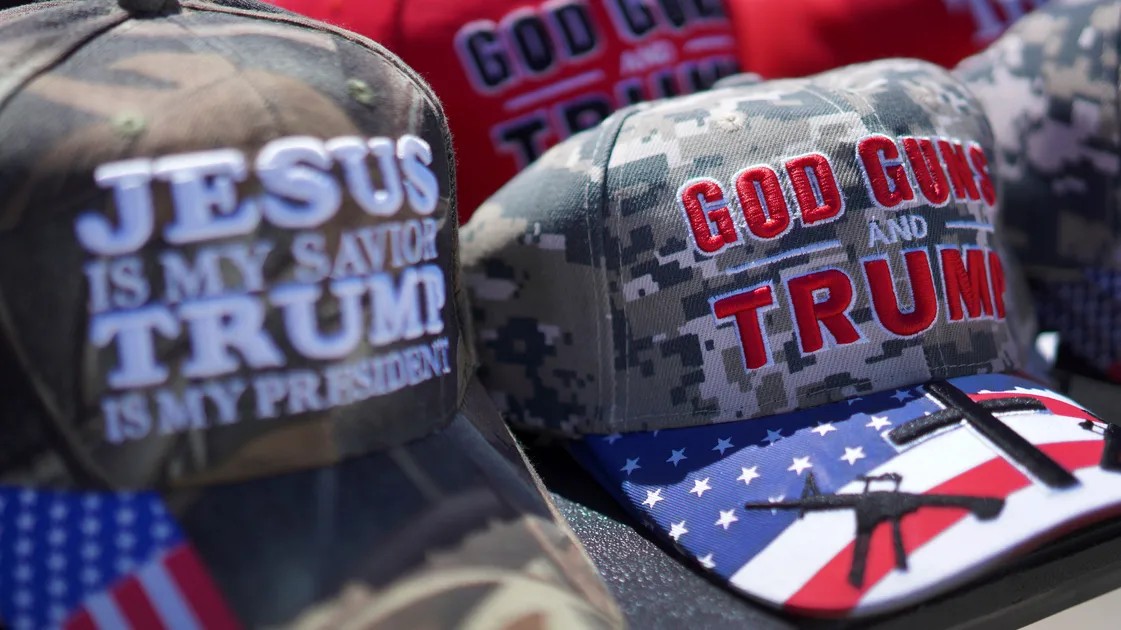
For many Americans, faith was once a matter of personal belief and community, not explicit political alignment. But in the past decade, the line between religion and ideology has blurred. As religious leaders increasingly endorse candidates from the pulpit and patriotic anthems mingle with worship music, congregations have fractured over public health, immigration, race, and cultural “morality.” This shift has led some believers to choose conviction over community—even if it means leaving the faith they grew up with.
Зміст
The Convergence of Faith and Politics
The merging of faith and politics isn’t new, but its intensity has risen sharply. What began as subtle endorsements has evolved into a full-fledged political alignment, particularly within certain evangelical circles. Anna Rollins, author of Famished, recalls a childhood where Christianity was presented as nearly inseparable from Republican identity. “Faith and freedom were often talked about in the same breath,” she explains, describing patriotic songs sung alongside hymns.
However, this entanglement can be dangerous. Deirdre Sugiuchi, whose memoir Unreformed details her experience in a white evangelical reform school, calls “MAGA Christianity” a cult. She argues that leaving isn’t just difficult—it can be a matter of survival. “I’m terrified about the merging of politics and Christianity,” she says, warning that unchecked faith-based organizations and religious freedom claims can undermine civil rights.
The Erosion of Trust
The embrace of partisan politics has fractured trust within many congregations. For Cara Meredith, author of Church Camp, the expectation was simple: “If you identified as Christian, you voted for the Republican Party; it was a matter of good and evil.” This rigid framing has left many questioning whether their faith has been hijacked by political agendas.
Critics argue that this shift subordinates core Christian teachings—caring for the poor, welcoming strangers—to a tribal political agenda. Amy Hawk, author of The Judas Effect, left her church after Donald Trump’s treatment of women clashed with her ministry. “It made no sense for me to support Trump,” she says.
The Breaking Point: When Beliefs Collide
The cracks began to form when believers reconciled their faith with political realities. Rollins found her doubts growing as she studied scripture. “Reading the Bible made me see that Christianity was not about aligning oneself with a nation-state,” she says. Sugiuchi’s turning point came after years of trauma at Escuela Caribe, an evangelical reform school where abuse was justified in the name of Jesus.
The realization that silence perpetuated harm pushed her to act. “By keeping silent, other people were being abused in the name of religion,” she says.
The Rise of “MAGA Christianity”
Tia Levings, author of A Well-Trained Wife, identifies “MAGA Christianity” as the intersection of authoritarian Christianity and Christian nationalism. She calls it a distortion of faith, where hyper-individualism, nationalism, and white supremacy are equated with Christianity. This has persisted due to unaccountable pastors, generational trauma bonding, and misinformation.
Levings argues that many remain tied to these communities because they don’t see an alternative. “Some people identify as MAGA because they have been taught that hyper-individualism, nationalism and white supremacy are the same as Christianity — and I think this is tragic. But I also think that many people identify as MAGA because they do not feel compelled by the alternative.”
The Cost of Leaving
Walking away isn’t easy. It means losing community, support, and a sense of belonging. Meredith describes the aftermath as a void in one’s life, disappearing from calendars, text messages, and social media.
Yet, for many, staying meant compromising their values. Hawk notes that white evangelicals often prioritize political power over genuine faith. “In the ten years since Trump came on the scene, I have learned that white evangelical spaces don’t follow Jesus as closely as they pretend to.”
Reclaiming Faith
For those who leave, the goal isn’t necessarily abandoning faith altogether, but reclaiming it. Some redefine their beliefs, keeping what feels authentic and discarding the rest. Others seek new communities outside politicized churches. Rollins affirms: “I’m still a Christian. I think that Christianity is a beautiful religion… I’ve certainly deconstructed the prosperity gospel, the perfectionism, the white supremacy and nationalism.”
Leaving “MAGA Christianity” is a rejection of political co-option, not necessarily of faith itself. It’s a choice to prioritize moral coherence over ideological conformity, even at the cost of community. Ultimately, many find that authentic faith requires disentangling belief from partisan agendas.