


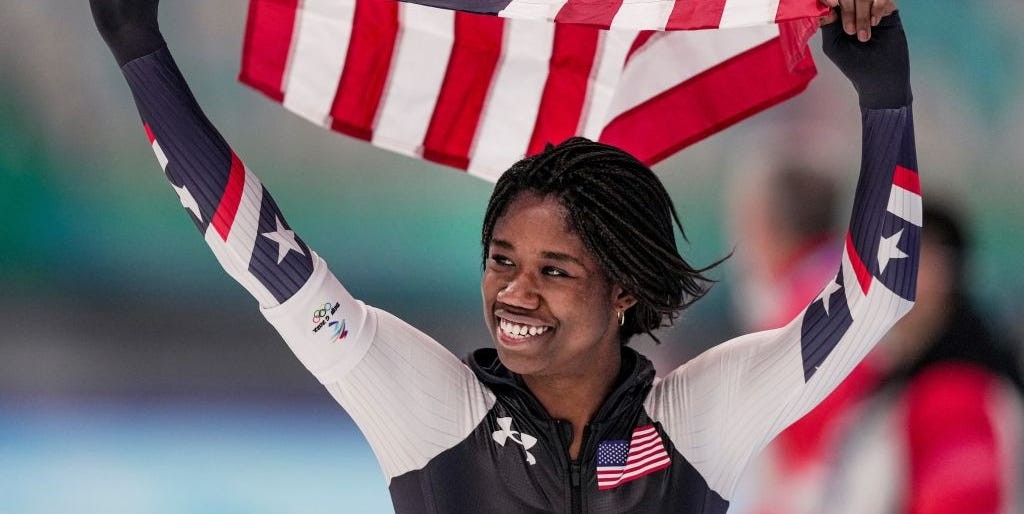
Olympic speed skater Erin Jackson, a gold medalist at the 2022 Beijing Games, approaches her sport with a refreshingly pragmatic mindset: enjoyment first, performance second. As she prepares for the 2026 Milan Cortina Olympics, her focus isn’t solely on defending her title but on sustaining a long-term career while prioritizing well-being. Jackson’s story reveals how elite athletes navigate pressure, injury, and the mental game to thrive.
Зміст
The Next Generation and Olympic Experience
Jackson is eager for the upcoming games in Italy, not just for her own performance but for her teammates. Many will be competing in their first or second Olympics, and the 2022 Beijing Games were severely restricted by COVID-19 protocols. She wants them to experience the full energy and excitement of the event.
Adapting to Injury and Expanding Horizons
At 33, Jackson is facing a significant challenge: three herniated discs in her lower back. This has forced her to rethink training methods, shifting away from high-impact exercises toward jogging and elliptical work. Despite slowing her initial pace, she’s adapting to minimize pain and maximize longevity.
Beyond the 500-meter sprint, where she excels, Jackson is now competing in the 1000-meter race. She qualified for this event at the 2026 trials and sees it as the most exciting race in the sport.
Recovery and Lifestyle Adjustments
Jackson emphasizes the importance of downtime and a supportive home environment. She prioritizes relaxation with her four pets and the presence of her father, who moved to Salt Lake City to be closer to her.
Her diet has also undergone a major overhaul to reduce inflammation. She now cooks more meals at home and maintains consistent eating times. A recent sleep study through the USOPC (U.S. Olympic & Paralympic Committee) revealed that regular sleep habits significantly improved her performance. She admits she never prioritized sleep before, but the data-driven approach changed her perspective.
Mental Fortitude: Self-Worth Beyond Medals
Jackson’s mental strength is a core component of her success. She deliberately avoids tying her self-worth to race results. A poor performance isn’t seen as a failure but as an opportunity for growth. She actively analyzes her races, focusing on both strengths and weaknesses.
This attitude stems from a non-traditional athletic background. She didn’t begin skating until after college, where she earned a degree in materials engineering. This academic foundation gives her a sense of security: winning is fun, but not essential.
Academic Pursuits: A Passion for Learning
Jackson’s intellectual curiosity extends far beyond the rink. She has earned an associate’s degree in computer science and is currently pursuing degrees in kinesiology and business, aiming to combine these fields into biomechanics. Her interest in prosthetics, sparked by interactions with adaptive athletes, could lead to future involvement in design and development.
Doubt, Fear, and the Long Game
Jackson’s approach is a testament to the power of adaptability and mental resilience. She doesn’t shy away from challenges, instead treating them as opportunities for growth and continuous learning. Her story illustrates how elite athletes can maintain peak performance while prioritizing long-term well-being and intellectual fulfillment.
Ultimately, Erin Jackson’s success isn’t just about speed; it’s about a balanced life where passion, persistence, and a thirst for knowledge converge.