



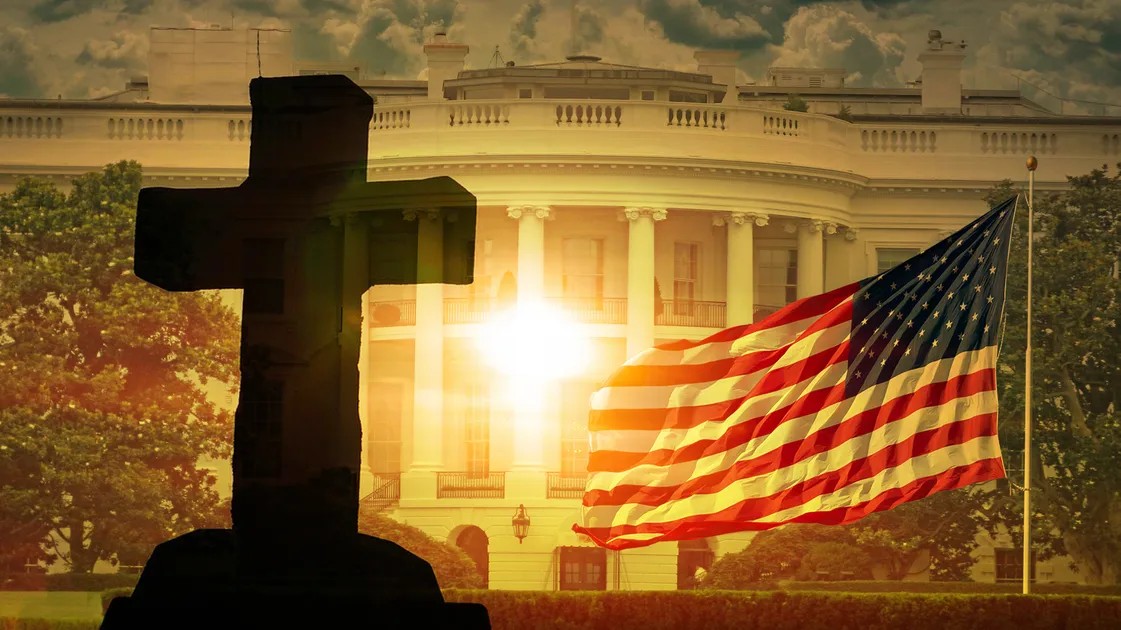
It used to be about Sunday school and potlucks. Now, for many, it is a battleground.
For decades, conservative Christianity in the American South and beyond felt like home. It was a matter of personal conviction, community bonds, and moral structure. But over the last ten years, something shifted. The boundary between belief and political ideology blurred. It disappeared.
Pulpits began endorsing candidates. Worship playlists mixed hymns with patriotic anthems. Congregations fractured over masks, immigration, and race. And when faith clashed with ideology, many believers chose to walk away. Even if it cost them their families. Even if it cost them everything.
Зміст
The High Cost of Disengaging from Christian Nationalism
Leaving is not a quiet exit. It is a rupture.
Jen Hamilton, a nurse and content creator, went viral for reading Matthew 25 alongside a sharp critique of MAGA politics. Her video crystallized a conversation percolating in the background for years. A commenter wrote in, reflecting their own journey: “I grew up Catholic but left because of the toxic views on ‘morality.’ If most Christians were more like you, I’d go back.”
For many, the entanglement of church and state has been spiritually devastating. What felt like a moral refuge suddenly felt like a siege.
Why Faith Became a Political Battleground
Anna Rollins, author of Famished: On Food, Sex, and Growing Up Good, grew up Southern Baptist. To her, being a “good Christian” meant following written and unwritten rules. Faith and freedom were spoken of in the same breath. Nationalism was woven into the fabric of Sunday services.
“Faith and freedom were often talked about… Nationalism was tightly woven in with Christianity.”
But for others, this overlap wasn’t just confusing. It was abusive.
Deirdre Sugiuchi, author of Unreformed, spent her formative years in a white evangelical reform school in Georgia. She calls MAGA Christianity a cult. She knows because she was trapped in it.
“MAGA Christianity is a cult. I had to escape to survive.”
Sugiuchi warns that many believers are brainwashed by systems of control. With unregulated faith-based organizations expanding and religious freedom claims undermining civil rights, silence becomes complicity. She points to the current political climate, noting that equating a president with God is tearing the country apart.
How Did We Get Here? The Rise of Authoritarian Faith
The fusion of faith and politics didn’t happen overnight. It was engineered.
Cara Meredith, author of Church Camp, describes a binary world where voting Republican was the only righteous choice. “It was a matter of good and evil,” she said. If you identified as Christian, you took the side God stood on. The other side? Evil. Simple. Absolute.
Critics argue this framework elevates obedience to authority over Jesus’ actual teachings. Love for the poor? Welcoming strangers? Standing with the marginalized? These took a backseat to political tribalism.
Amy Hawk, an ex-vangelical author of The Judas Effect, found a breaking point. She ran a ministry helping assaulted women. When Donald Trump’s comments about women surfaced, the cognitive dissonance became unbearable.
“It made no sense for me to support Trump. His treatment of women went against the ministry I was heading up.”
For Hawk, the embrace of Trumpism was “too great to ignore.” Her family left the church. Political allegiance had become a proxy for spiritual fidelity, and she refused to buy it.
The Cracks in the Foundation: Reading Between the Lines
For many, the Bible itself became the tool for deconstruction.
Anna Rollins returned to Scripture and found no endorsement for nationalism. In fact, she found the opposite. Jesus was killed, in part, for refusing to serve political movements. The church’s adherence to the state seemed contradictory to the text they claimed to revere.
Deirdre Sugiuchi’s turning point came after years of trauma. Sent to a reform school at 15 for failing to be “subservient,” she endured oppression justified as being “for our own good.” In 2005, she read Julia Scheeres’ Jesus Land. She visited the campus. She saw the whitewashing of abuse. She realized her silence enabled harm.
“By keeping silent, other people were being abusive… It completely destroys your faith in humanity.”
With help, she helped shut the school down. She kept her personal faith but severed ties with organized religion.
Tia Levings, author of A Well-Trained Wife, defines MAGA Christianity as the intersection of authoritarianism and Christian nationalism. She calls it a malformation. Jesus wasn’t a nationalist. He wasn’t an authoritarian. Yet modern churches failed to protect congregations from these influences.
Levings argues that trauma bonding, unaccountable pastors, and a lack of critical thinking skills created a vacuum. Misinformation filled it. Groupthink replaced theology.
“Some people identify as MAGA because… hyper-individualism, nationalism and white supreme are the same as Christianity.”
But it isn’t just ideology. It’s also a lack of compelling alternatives. As Rollins noted, many stay because they feel they have no other home.
The Final Straw: Why They Walked Away
Leaving rarely happens in a single moment. It is usually a slow erosion. A series of small realizations that accumulate until the foundation cracks.
Cara Meredith spent 20 years disentangling herself. She saw the “monumental” events—the killing of George Floyd, the Capitol insurrection, the mishandling of COVID-19—but the exit wasn’t about one headline.
“It tends to be a series of lots of small things that make you realize: something is wrong.”
Meredith highlights the racial blind spots in evangelical spaces. White evangelicals often ignore systems that benefit them, trusting pastors implicitly. “How or why could a pastor lead them astravay?” Meredith asks. The assumption of moral infallibility in leadership stifles questioning.
Amy Hawk sums up the disconnect clearly. After ten years of watching Trump’s rise, she concluded that white evangelical spaces prioritize political power over truth.
“There has been a mass indoctrination… that looks absolutely nothing like the Christ I claim to serve.”
What Happens After You Leave?
The exit fee is high.
When you are in, the community is your safety net. They bring casseroles. They watch your kids. They pray for you. When you leave, that support vanishes. Overnight.
Meredith describes the void left behind—not just in the soul, but in the calendar. In the text messages. In the social media feed. “You are cast to the side,” she says.
But for those who leave, it is often a reclamation of self.
Anna Rollins remains a Christian. She still finds beauty in the faith, particularly its focus on grace and hope. But she has deconstructed the prosperity gospel. She has rejected perfectionism and white supremacy.
Tia Levings notes that life requires growth. A static faith becomes finite. Leaving was necessary to survive.
Amy Hawk still loves Jesus. She just stopped recognizing him in the spaces that bore his name. The church, she found, had shifted from a place of faith to one of fear. Control. Exclusion.
The door was open. Many just finally walked through it.