



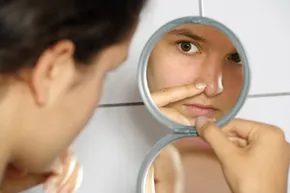
You know the feeling. One morning you look in the mirror and there it is. A bright red beacon on the tip of your nose. It feels like it has its own gravitational pull. You want to pull the hood of your sweatshirt up. You want to hide your head in a paper bag. Or better yet, just vanish.
Here is the truth though. You are not alone.
The skin on your face is more than just a barrier. It is a billboard for your self-worth. When that billboard gets tagged with a blemish, the psychological fallout can be heavier than the physical spot itself. Many people with frequent breakouts operate under the assumption that everyone is staring at their flaws. They think their acne is the first thing people notice. The last thing.
This belief breeds embarrassment. It breeds humiliation. And over time, it chips away at self-esteem until you feel small.
The Spotlight Effect Is a Lie
Let’s talk about the math of attention.
If you have a breakout now and then, the odds are good that nobody cares. You look in the mirror. You see a crater. You feel like you have grown a third eye right between your brows. But unless you are a model, an actor, or someone whose job requires you to be scrutinized from three feet away, people are not looking that closely.
They are thinking about their emails. Their lunch. Their own insecurities.
If your breakouts are severe. If they are constant. Then yes. People might notice. But even then, they do not see your skin the way you do. You study your reflection under harsh bathroom lights. You pick at the texture. You zoom in on the redness. Most people see a vague impression of your face. They do not see the details you are obsessed with.
When It Goes Beyond Self-Consciousness
Knowing people aren’t staring does not stop the discomfort. The embarrassment still sits in your chest. It still makes you want to cancel plans.
Dermatologists take these feelings seriously. They know that negative emotions from breakouts can spiral. They can lead to depression. Anxiety. Social withdrawal. You stop going to the party. You skip the date. You stay home.
In extreme cases, this distortion of body image can progress to body dysmorphic disorder. This is a mental health condition. It causes people to obsess over perceived flaws. They believe others are singling them out. They go to great lengths to hide or fix these flaws. They spend hours checking mirrors. They spend money on products that don’t work.
“Acne vulgaris is more than skin deep.”
Breaking the Cycle
If your skin is affecting your work. If it is souring your relationships. If it is controlling your social life, it is time to act.
You have options.
- See a dermatologist. They can help you decide which treatment path is right. This ranges from over-the-counter washes to prescription medications.
- Talk to your physician. If the anxiety is heavy. If you feel depressed about your appearance, your general doctor can help. They might suggest counseling. Or antidepressants. Depending on the severity of your symptoms.
Treating the skin helps the confidence. But treating the mind helps the life.
Dealing with blemishes is not a picnic. It is frustrating. It is exhausting. But your breakouts do not have to control your days.
Next time you feel someone staring at that spot on your nose. Hold your head high. Smile. Let them wonder why you are so calm. Let them miss the point.
You are more than your skin. Even when that skin is acting up.
Sources:
* American Academy of Dermatology. “The Social Impact of Acne.”
* New Zealand Dermatological Society Inc. “Psychological Effects of Acne.”
* Hanna, Shannon; Jasdeep Sharma; and Jennifer Klotz. “Acne vulgaris: More than skin deep.” Dermatology Online Journal.
* Mayo Clinic. “Body Dysmorphic Disorder.”
* WebMD. “Teen Acne: Prescription Treatments for Acne.”